
.png)
The Procurement Act 2023, representing one of the most significant overhauls of UK procurement law, came into full force on 24th February 2025. Moving away from pre-existing EU directives, this legislation was designed for the requirements of a post-Brexit Britain: creating a transparent, flexible and accessible public procurement landscape for UK SMEs, which form the backbone of the UK economy.
To mark the first anniversary of the Act earlier this year, PUBLIC hosted a panel discussion at The GovTech Summit titled, ‘The Procurement Act One Year On: Is It Working for Innovation?’. Reflecting on the discussions and in-depth analysis of notices and awards published between March 2025 - 2026, this article explores the successes, challenges and impact of this landmark procurement legislation on the UK public sector.
While the Procurement Act delivers against several goals, this review focuses on the legislation’s promise to transform public procurement through three specific levers:
For the first time in the UK’s history, the Procurement Act led to a centralised system for tracking and monitoring procurement data. Through the Central Digital Platform (CDP) and Contracts Finder (CF), each contracting authority is provided with a unique Open Contracting ID (OCID) for every procurement, allowing suppliers to track opportunities from planning and tender to the award stage. Furthermore, the Find a Tender Service (FTS) now publishes live procurement data in a structured, machine-readable format via an API, making data more accessible than ever before. In simple terms, while Find a Tender (FTS) is the public shop window where you search for contracts, the Central Digital Platform (CDP) is the engine running behind the scenes. The CDP stores a supplier’s core details so they only have to register once, then plugs that information into FTS. Together, they create a digital trail that tracks a project from the first day of planning all the way to the final award, cutting down on repetitive paperwork for everyone involved.
As part of this transparency push, the legislation mandated that contracting authorities publish planning and pre-market engagement notices above certain thresholds. These notices provide UK SMEs with the necessary runway to plan internally and engage with authorities to shape opportunities before they reach the proposal stage. Since February 2025, FTS has recorded the publication of 10,610 pre-market engagement notices and 8,582 pipeline and planned procurement notices. The sheer volume of these publications signals their effectiveness in stimulating earlier, more productive conversations between public buyers and suppliers.
Greater transparency has also exposed notable gaps in the procurement pipeline. Analysis shows that, since the implementation of the Act, a substantial share of opportunities have seemingly stalled; only 21% of planning notices and 32% of pre-market engagement notices advanced to the tender stage. This drop-off is even sharper at the award stage, with just 10% of planning notices and 15% of procurement notices ultimately resulting in contracts.
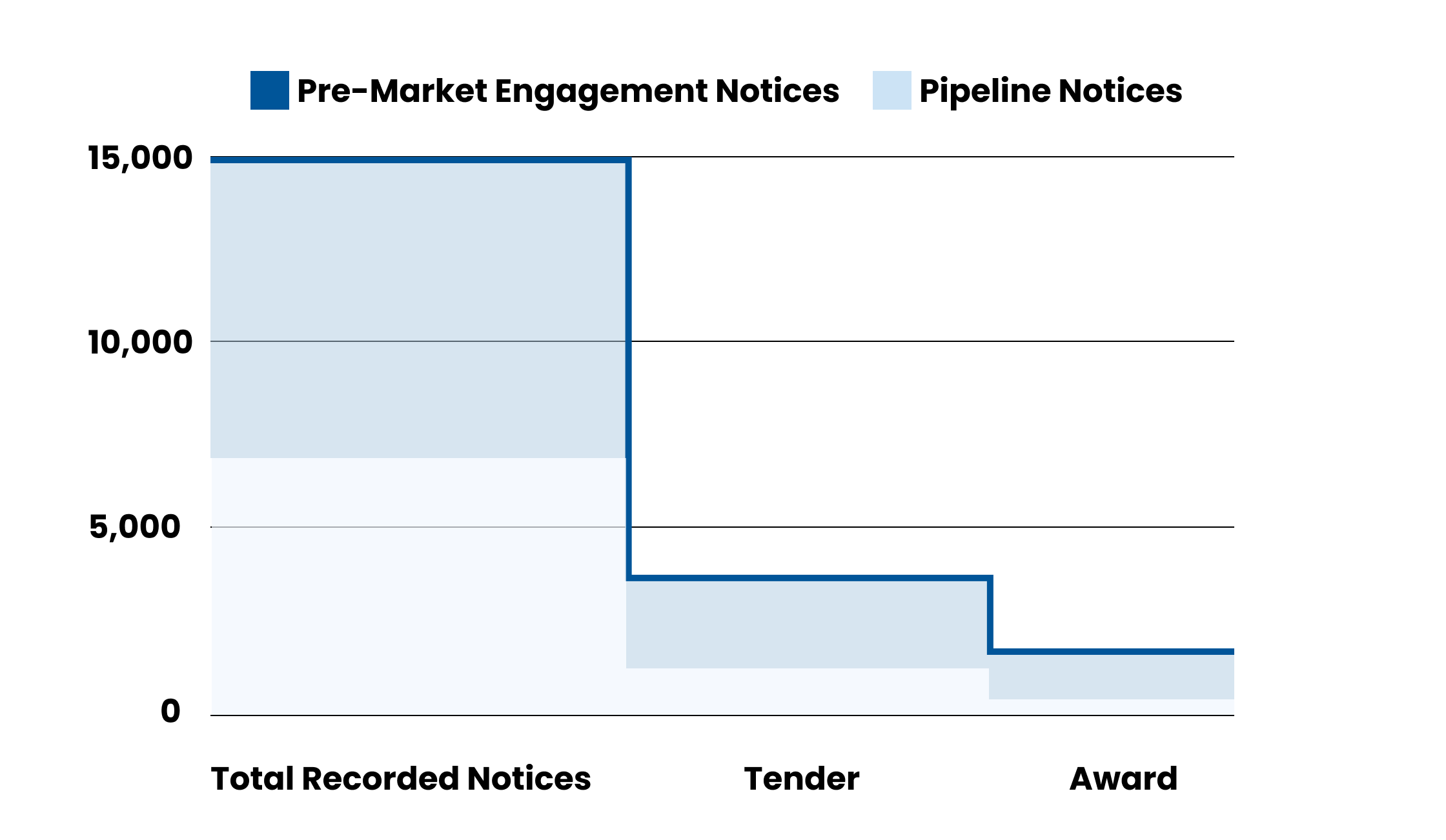
However, this picture requires nuance. Between 2021–2023, the average procurement took approximately 358 days to move from planning to award. This suggests many notices published in 2025 are likely still progressing through the pipeline rather than being abandoned. Nevertheless, this time lag and the lack of a guarantee that an opportunity will progress continue to cause friction for SMEs. Furthermore, FTS data does not yet provide clarity on which opportunities are abandoned, redirected, or merged, making it difficult for suppliers to assess the true probability of a contract proceeding.
Separately, local councils have noted that several large e-sourcing tools failed to effectively upgrade their systems to support new legal requirements, such as the automated publication of transparency notices to the CDP. In the absence of these capabilities, councils have had to publish notices manually, adding a layer of administrative work to an already bureaucratic process.
Ultimately, data publication is merely the first step toward achieving genuine accountability in public procurement. Overcoming these pipeline bottlenecks and technical hurdles will require much closer alignment between public sector buyers, e-sourcing vendors, and commercial teams.
The success of the Procurement Act relies on its ability to simplify public procurement and enhance SME engagement. Under the Act, this simplification was driven by the introduction of the Competitive Flexible Procedure (CFP). The CFP replaces several complicated EU procedures, such as competitive dialogue and competitive procedure with negotiation, enabling authorities to design flexible, outcome-focused, and market-aligned competitions.
Since implementation, approximately 2,885 procurements have been carried out via CFP, representing around 5.8% of total procurements. This indicates a small but steady adoption of this complex provision. Discussions with public sector officials suggest that while many have struggled with the newfound flexibility, the procedure is being successfully used for high-value, complex procurements across health, social care, infrastructure, and insurance: areas where buyers benefit from the ability to negotiate and refine solutions over multiple stages.
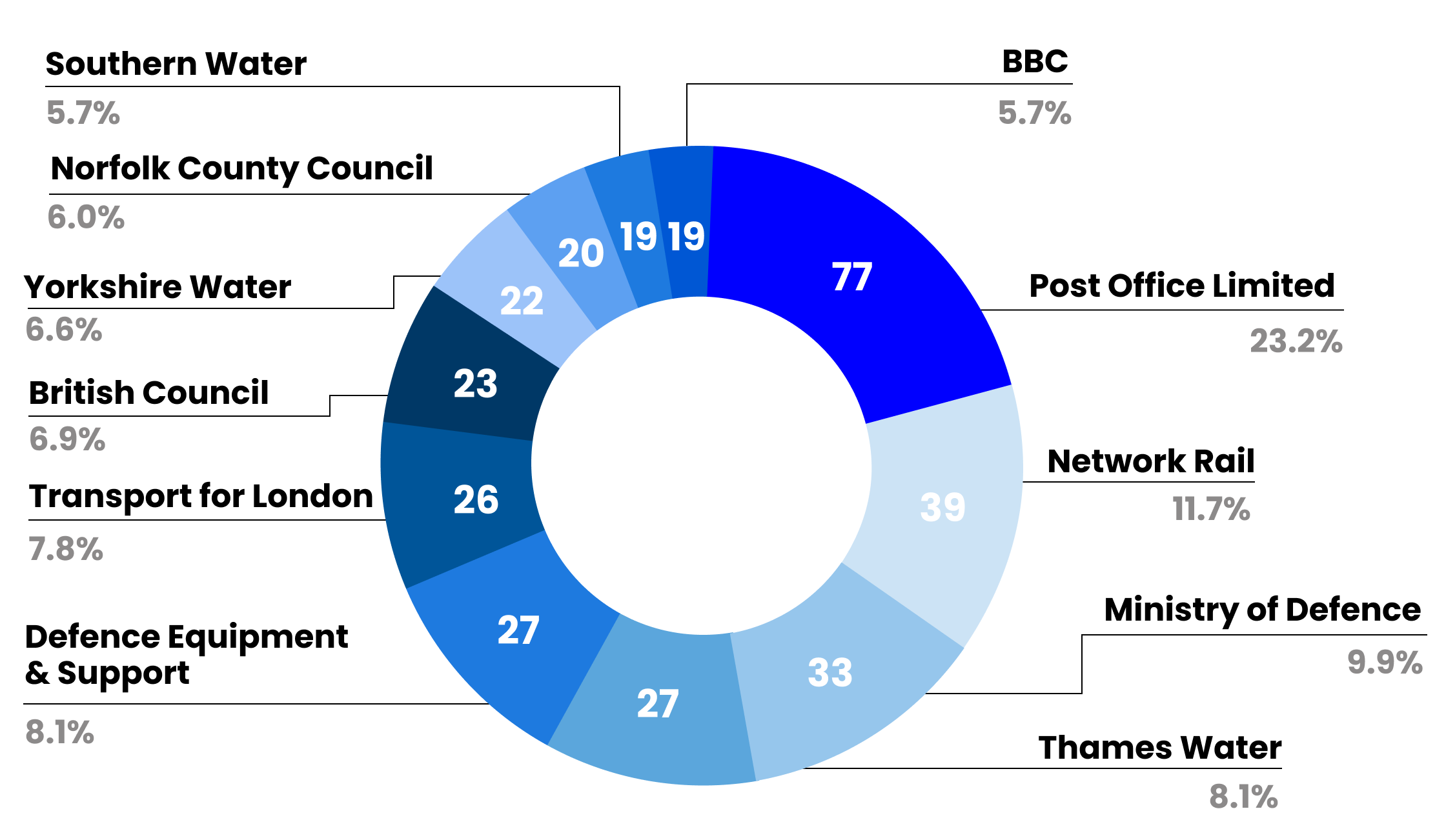
As clear in the figure above, authorities most actively using CFP are those with a stronger appetite for innovation, leveraging the procedure to procure cutting-edge products and services. This generally includes central government departments who have dedicated procurement teams, bigger budgets and internal capacity to experiment and take risks. For example, HMRC’s 2025 competition to close the tax gap utilised a multi-stage challenge where bidders submitted five-minute video pitches and participated in technical workshops. This streamlined process allowed judges to evaluate the most creative approaches to complex tax issues, culminating in a high-profile final presentation of the winning solutions at Downing Street.
There remains a challenge in extending the use of the CFP beyond high-value procurements. The true value of this provision lies in designing creative competitions for all procurement types, from the mundane to the complex. This requires a large-scale mindset shift; procurement professionals must move beyond traditionally safe pathways to design competitions that truly work for their specific needs.
In the past year, we have seen a few gold-standard examples, such as the Newport City Council procurement of tree surgeons and consultants, that shine light on how this procedure can drive outcomes beyond high-value procurements. Following early market engagement, the council invited shortlisted suppliers to an on-site demonstration day. Suppliers who proved most proficient in crown reduction and pruning skills were directly awarded long-term contracts. While there is consensus on the transformative nature of the CFP, as stakeholders at the summit highlighted: “The Procedure is only as good as the people using it.”
SMEs constitute over 99% of the UK business population, yet they have historically found it difficult to work with the public sector. Barriers have ranged from navigating complex processes to the resource-heavy nature of end-to-end procurement and high entry points in legal frameworks. The Procurement Act 2023 promised to lower these hurdles through several mandates:
Local government experts have widely welcomed the provision to reserve below-threshold contracts for local SMEs, offering smaller and rural councils a powerful lever to support their local economies. Early data shows promising signs of structural change: out of 25,740 procurements analysed over the past year, 3,175 (12.3%) were deliberately divided into two or more lots to encourage smaller bidders. Furthermore, FTS has successfully established itself as the sector's 'single source of truth,' processing over 40,000 procurements and 15,000 award notices since February 2025.
It remains difficult to assess the progress of certain provisions, such as prompt payment policies and direct awards, due to implementation delays and data gaps. Additionally, inefficient tagging on the Central Digital Platform (CDP) makes it hard to track how many contracts were awarded to SMEs last year. This is a platform-wide issue: while the CDP tags all suppliers in its registry by SME status, it does not currently publish this information on award notices.
Bridging this data gap must be a priority for the CDP roadmap. To move from simple compliance to meaningful insight, the platform needs to ensure that supplier registry tags are automatically mapped and published within every Award Notice. Enhancing these tagging provisions, alongside the recent inclusion of below-threshold contract data, would finally provide the public with a clear, data-driven picture of how many contracts are truly supporting the UK’s SME community.
The first year of the Procurement Act was defined by significant structural change. Overall, the public sector, traditionally a risk-averse buyer, has adapted to the new regime without major disruption. While there is clear progress in transparency, operational efficiency and SME participation, sustained growth will require a greater capacity for experimentation, trust, and collaboration.
With the rise of AI in procurement, the Act serves as a vital lever to rethink public spending from the ground up. As we enter year two, the question remains: will the sector move beyond compliance to fully embrace commercial bravery?
PUBLIC’s Commercial, Spend and Impact Team is committed to supporting UK central, local and wider public sector authorities to unlock commercial outcomes through better adoption of modern, proportionate and outcome-focused procurement practices and machinery. If you have any reactions to this article, want to share your experience or are in-general interested in procurement innovation, feel free to reach out to disha.shanbhag@public.io.

Partners

How can we harness AI's potential to make impact evaluations quicker and more robust, while learning how to safeguard essential human judgment?


Our latest article, focusing on the Procurement Act 2023's shift to "Most Advantageous Tender" (MAT), and its implications for social value, sustainability, and data transparency in public procurement.

Discover how local areas can build innovation clusters by aligning national priorities with regional strengths, unlocking economic growth and technological progress.

The Department for Transport has published its strategy for the future of the maritime sector - Maritime 2050. Here's how to build the UK's first smart port.

Key takeaways from a panel of experts from the public sector, academia and private sector advisors, on methods for evaluating digital projects.

PUBLIC’s latest guide for teams conducting digital evaluations. Building on our first edition earlier this year, this guide brings together practical advice and examples to help public sector teams measure the impact of their digital projects, by using best-in-class research methods from other fields,
.png)
PUBLIC's perspective on Labour's mission to make Britain a clean energy superpower and the challenge of turning political promises into tangible progress.

An innovative solution tailored to support local councils in delivering their digital services.
.png)
Exploring strategies for empowering local authorities.

A practical guide for evaluating digital, data and technology projects in the UK public sector; in this article, the guidebook’s authors, Johnny Hugill and Dr. Steffen Triebel explain its context and objectives.

In the first of our Expertise Spotlight Series, we sit down with Johnny Hugill, Deputy Director of Commercial, Spend & Impact at PUBLIC, to discuss shaping the UK’s landmark Procurement Act, insights into this transformative legislation, and the opportunities for driving innovation in procurement.

PUBLIC has partnered with Ignite Procurement to help public authorities to deliver more intelligent and sustainable procurement.

